Read Modbus Tcp and Convert to Analog

In this article, yous will learn about the Modbus TCP protocol, which is the evolution of the Modbus RTU protocol.
Contents:
- Where to send a Modbus TCP control?
- Description of the Modbus TCP protocol
- Modbus TCP command types
- How practise I send a Modbus TCP control to read discrete output? Command 0x01
- How to send a Modbus TCP control to read a digital input? Command 0x02
- How to transport a Modbus TCP command to read the analog output? Command 0x03
- How to ship a Modbus TCP command to read an analog input? Command 0x04
- How practise I transport a Modbus TCP command to write discrete output? Command 0x05
- How practice I ship a Modbus TCP command to record analog output? Command 0x06
- How do I send a Modbus TCP control to write multiple discrete pins? Control 0x0F
- How do I ship a Modbus TCP command to write multiple analog outputs? Command 0x10
- Modbus TCP request errors
- Programs for working with the Modbus TCP protocol
- Equipment with Modbus TCP back up
Where to transport a Modbus TCP command?
In an Ethernet network, the device address is its IP address. Typically, devices are on the same subnet, where IP addresses differ by the last two digit 192.168.1. 20 when using the about mutual subnet mask 255.255.255.0.
The interface is an Ethernet network, the data transfer protocol is TCP / IP.
The TCP port used is: 502.
Dorsum to contents
Description of the Modbus TCP protocol
The Modbus TCP command consists of a portion of the Modbus RTU message and a special header.
From the Modbus RTU message, the SlaveID address at the beginning and the CRC checksum at the end are removed, which forms the PDU, the Protocol Data Unit.
The following is an example of a Modbus RTU request for obtaining the AI value of the belongings registers from registers # 40108 to 40110 with the address of the device 17.
11 03 006B 0003 7687
| xi | Device address SlaveID (17 = eleven hex) |
| 03 | Function Code (read Analog Output Belongings Registers) |
| 006B | Address of the offset register (40108-40001 = 107 = 6B hex) |
| 0003 | The number of required registers (reading three registers from 40108 to 40110) |
| 7687 | Checksum CRC |
We drop the address of the SlaveID device and the CRC checksum and go the PDU: 03 006B 0003
03 006B 0003
At the offset of the received PDU message, a new vii-byte header is added, which is called MBAP Header (Modbus Application Header). This header has the following data:

Transaction Identifier: ii bytes are set by the Master to uniquely identify each asking. Tin be any. These bytes are repeated by the Slave device in the response, since the responses of the Slave device may non always be received in the aforementioned gild as the requests.
Protocol Identifier: 2 bytes are set by the Master, will e'er be 00 00, which corresponds to the Modbus protocol.
Length: ii bytes are set past the Master, identifying the number of bytes in the message that follow. It is counted from Unit Identifier to the end of the bulletin.
Unit Identifier: 1 byte is set to Chief. Information technology is repeated by the Slave device to uniquely identify the Slave device.
Total nosotros get:
| Modbus RTU | Slave ID | Enquiry | CRC |
|---|---|---|---|
| Modbus RTU | 11 | 03 006B 0003 | 7687 |
| Modbus TCP | 0001 0000 0006 xi | 03 006B 0003 | |
| Modbus TCP | MBAP Header | PDU | |
| Modbus TCP | ADU, Awarding Data Unit | ||
Where:
| 0001 | Transaction identifier | Transaction Identifier |
| 0000 | Protocol identifier La | Protocol Identifier |
| 0006 | Length (6 bytes are followed) | Message Length |
| 11 | The device accost (17 = xi hex) | Unit of measurement Identifier |
| 03 | Function code (read Analog Output Holding Registers) | Function Code |
| 006B | Commencement address register (107 = 40108-40001 = 6B hex) | Data Address of the starting time register |
| 0003 | The number of required registers (read three registers 40108 by 40110) | The total number of registers |
In the response from the Modbus TCP Slave device we become:
0001 0000 0009 11 03 06 022B 0064 007F
Where:
| 0001 | Transaction identifier | Transaction Identifier |
| 0000 | Protocol identifier | Protocol Identifier |
| 0009 | The length (9 bytes are followed) | Message Length |
| 11 | The device accost (17 = 11 hex) | Unit Identifier |
| 03 | Office code (read Analog Output Property Registers) | Function Code |
| 06 | The number of bytes subsequently (half dozen bytes are followed) | Byte Count |
| 02 | Value of the high register chip (02 hex) | Annals value Hullo (AO0) |
| 2B | Early discharge value register (2B hex) | Register value Lo (AO0) |
| 00 | Value of the high annals chip (00 hex) | Annals value Hi (AO1) |
| 64 | Value of the low register bit (64 hex) | Annals value Lo (AO1) |
| 00 | Value of the high register bit (00 hex) | Annals value Hullo (AO2) |
| 7F | Early discharge value register (7F hex) | Annals value Lo (AO2) |
The analog output register AO0 has the value 02 2B HEX or 555 in the decimal organization.
The analog output register AO1 has the value 00 64 HEX or 100 in the decimal arrangement.
The analog output register AO2 has the value 00 7F HEX or 127 in the decimal arrangement.
Back to contents
Modbus TCP command types
Here is a table with the codes for reading and writing the Modbus TCP registers.
| Function Code | What the function does | Value blazon | Access type | |
|---|---|---|---|---|
| 01 (0x01) | Reading Practise | Read Coil Condition | Detached | Reading |
| 02 (0x02) | Reading DI | Read Input Condition | Discrete | Reading |
| 03 (0x03) | Reading AO | Read Holding Registers | 16 bit | Reading |
| 04 (0x04) | Reading AI | Read Input Registers | 16 bit | Reading |
| 05 (0x05) | One Practise recording | Force Unmarried Ringlet | Discrete | Recording |
| 06 (0x06) | Recording i AO | Preset Unmarried Register | 16 bit | Recording |
| 15 (0x0F) | Multiple DO recording | Forcefulness Multiple Coils | Discrete | Recording |
| 16 (0x10) | Recording multiple AOs | Preset Multiple Registers | xvi bit | Recording |
Back to contents
How do I send a Modbus TCP command to read discrete output? Command 0x01
This command is used to read the values of the Practice digital outputs.
The PDU request specifies the start address of the kickoff Do annals and the subsequent number of required DO values. In the PDU, the DO values are addressed starting from zero.
The DO values in the response are in one byte and stand for to the value of the $.25.
The bit values are defined as one = ON and 0 = OFF.
The low bit of the starting time data byte contains the DO value whose address was specified in the request. The remaining values of Do follow the increasing value to the highest value of the byte. Those. from right to left.
If less than 8 Practice values were requested, the remaining bits in the response will be filled with zeros (in the direction from the depression to high byte). Field Byte Count Number byte further indicates the number of full information bytes in response.
| Byte | Request | Byte | Reply |
|---|---|---|---|
| (Hex) | Field proper noun | (Hex) | Field name |
| 01 | Transaction identifier | 01 | Transaction identifier |
| 02 | 02 | ||
| 00 | Protocol identifier | 00 | Protocol identifier |
| 00 | 00 | ||
| 00 | Message length | 00 | Bulletin length |
| 06 | 04 | ||
| 01 | Device address | 01 | Device address |
| 01 | Functional lawmaking | 01 | Functional code |
| 00 | Address of the kickoff byte of annals Hi | 01 | Number of bytes more |
| 00 | Accost of the first byte of annals Lo | 02 | The value of register DO 0-1 |
| 00 | Number of registers Hello Byte | ||
| 02 | Number of registers Lo Byte | ||
The output states DO0-1 are shown as 02 hex values, or in the binary arrangement 0000 0010.
The DO1 value will be the second to the right, and DO0 will be the first on the correct (low-order bit).
The other six bits are filled with zeros to the total byte, because They were not requested.
| Channels | - | - | - | - | - | - | Practice one | Exercise 0 |
| Bits | 0 | 0 | 0 | 0 | 0 | 0 | i | 0 |
| Hex | 02 | |||||||
Back to contents
How to send a Modbus TCP command to read a digital input? Command 0x02
This command is used to read the values of digital inputs DI.
The query and response for DI is similar to the query for DO.
| Byte | Request | Byte | Answer |
|---|---|---|---|
| (Hex) | Field proper name | (Hex) | Field name |
| 01 | Transaction identifier | 01 | Transaction identifier |
| 02 | 02 | ||
| 00 | Protocol identifier | 00 | Protocol identifier |
| 00 | 00 | ||
| 00 | Bulletin length | 00 | Bulletin length |
| 06 | 04 | ||
| 01 | Device address | 01 | Device address |
| 02 | Functional code | 02 | Functional code |
| 00 | Address of the first byte of register Hi | 01 | Number of bytes more than |
| 00 | Address of the kickoff byte of register Lo | 03 | The value of annals DI 0-one |
| 00 | Number of registers Hi Byte | ||
| 02 | Number of registers Lo Byte | ||
The output states of DI 0-1 are shown as 03 hex values, or in the binary system 0000 0011.
The DI1 value will be the 2nd to the right, and the value of DI0 will be the first right (low-guild flake).
The other six bits are filled with zeros.
Dorsum to contents
How to transport a Modbus TCP command to read the analog output? Control 0x03
This command is used to read the values of the analog outputs AO.
| Byte | Request | Byte | Answer |
|---|---|---|---|
| (Hex) | Field proper name | (Hex) | Field name |
| 01 | Transaction identifier | 01 | Transaction identifier |
| 02 | 02 | ||
| 00 | Protocol identifier | 00 | Protocol identifier |
| 00 | 00 | ||
| 00 | Message length | 00 | Message length |
| 06 | 07 | ||
| 01 | Device address | 01 | Device address |
| 03 | Functional lawmaking | 03 | Functional lawmaking |
| 00 | Accost of the first byte of register Hi | 04 | Number of bytes more than |
| 00 | Address of the first byte of register Lo | 02 | Register value Hullo (AO0) |
| 00 | Number of registers Hi Byte | 2B | Register value Lo (AO0) |
| 02 | Number of registers Lo Byte | 00 | Register value Hullo (AO1) |
| 64 | Register value Lo (AO1) | ||
The output states AO0 are shown as 02 byte 2B hex, or in the decimal organization 555.
The output states AO1 are shown every bit the byte values 00 64 hex, or in the decimal organisation 100.
Back to contents
How to send a Modbus TCP control to read an analog input? Command 0x04
This command is used to read the values of analog inputs AI.
| Byte | Asking | Byte | Answer |
|---|---|---|---|
| (Hex) | Field name | (Hex) | Field name |
| 01 | Transaction identifier | 01 | Transaction identifier |
| 02 | 02 | ||
| 00 | Protocol identifier | 00 | Protocol identifier |
| 00 | 00 | ||
| 00 | Message length | 00 | Message length |
| 06 | 07 | ||
| 01 | Device address | 01 | Device accost |
| 04 | Functional code | 04 | Functional code |
| 00 | Address of the get-go byte of register Hi | 04 | Number of bytes more |
| 00 | Accost of the first byte of register Lo | 00 | Annals value Hi (AI0) |
| 00 | Number of registers Hello Byte | 0A | Annals value Lo (AI0) |
| 02 | Number of registers Lo Byte | 00 | Register value How-do-you-do (AI1) |
| 64 | Register value Lo (AI1) | ||
The output states AI0 are shown as 00 0A hex values, or in the decimal organization 10.
The output states AI1 are shown every bit the byte values 00 64 hex, or in the decimal organisation 100.
Back to contents
How practise I send a Modbus TCP command to write discrete output? Command 0x05
This control is used to record i value of the Practice digital output.
The value of FF 00 hex sets the output to ON.
The value 00 00 hex sets the output to OFF.
All other values are invalid and will not impact the output state.
The normal response to such a request is an echo (a repeat request in the response), is returned afterwards the DO state has been changed.
| Byte | Asking | Byte | Respond |
|---|---|---|---|
| (Hex) | Field name | (Hex) | Field name |
| 01 | Transaction identifier | 01 | Transaction identifier |
| 02 | 02 | ||
| 00 | Protocol identifier | 00 | Protocol identifier |
| 00 | 00 | ||
| 00 | Message length | 00 | Message length |
| 06 | 06 | ||
| 01 | Device address | 01 | Device address |
| 05 | Functional code | 05 | Functional code |
| 00 | Hi Register Accost byte | 00 | Hi Register Accost byte |
| 01 | Lo Register Address byte | 01 | Lo Annals Address byte |
| FF | Hi Byte Meaning | FF | Howdy Byte Meaning |
| 00 | Lo Byte Pregnant | 00 | Lo Byte Meaning |
The output condition of DO1 has inverse from OFF to ON.
Back to contents
How practice I send a Modbus TCP command to record analog output? Command 0x06
This command is used to tape one value of the analog output AO.
| Byte | Request | Byte | Answer |
|---|---|---|---|
| (Hex) | Field proper name | (Hex) | Field name |
| 01 | Transaction identifier | 01 | Transaction identifier |
| 02 | 02 | ||
| 00 | Protocol identifier | 00 | Protocol identifier |
| 00 | 00 | ||
| 00 | Bulletin length | 00 | Message length |
| 06 | 06 | ||
| 01 | Device address | 01 | Device address |
| 06 | Functional code | 06 | Functional lawmaking |
| 00 | Hi Register Accost byte | 00 | Hi Register Accost byte |
| 01 | Lo Annals Address byte | 01 | Lo Register Address byte |
| 55 | Hi Byte Meaning | 55 | How-do-you-do Byte Meaning |
| FF | Lo Byte Meaning | FF | Lo Byte Meaning |
The output status of AO0 has changed to 55 FF hex, or in the decimal arrangement 22015.
Back to contents
How practise I send a Modbus TCP command to write multiple discrete pins? Command 0x0F
This command is used to record multiple values of Practice's digital output.
| Byte | Request | Byte | Answer |
|---|---|---|---|
| (Hex) | Field name | (Hex) | Field proper noun |
| 01 | Transaction identifier | 01 | Transaction identifier |
| 02 | 02 | ||
| 00 | Protocol identifier | 00 | Protocol identifier |
| 00 | 00 | ||
| 00 | Message length | 00 | Bulletin length |
| 08 | 06 | ||
| 01 | Device address | 01 | Device address |
| 0F | Functional code | 0F | Functional code |
| 00 | Accost of the starting time byte of register Howdy | 00 | Accost of the outset byte of register Howdy |
| 00 | Address of the first byte of register Lo | 00 | Address of the outset byte of register Lo |
| 00 | Number of registers Hi Byte | 00 | Number of recorded reg. Hi byte |
| 02 | Number of registers Lo Byte | 02 | Number of recorded reg. Lo bytes |
| 01 | Number of bytes more than | ||
| 02 | Byte Value | ||
The output status of DO1 has inverse from OFF to ON.
The DO0 output land remains OFF.
Back to contents
How exercise I ship a Modbus TCP command to write multiple analog outputs? Control 0x10
This command is used to record multiple values of the analog output AO.
| Byte | Asking | Byte | Respond |
|---|---|---|---|
| (Hex) | Field name | (Hex) | Field name |
| 01 | Transaction identifier | 01 | Transaction identifier |
| 02 | 02 | ||
| 00 | Protocol identifier | 00 | Protocol identifier |
| 00 | 00 | ||
| 00 | Message length | 00 | Message length |
| 0B | 06 | ||
| 01 | Device address | 01 | Device address |
| x | Functional lawmaking | 10 | Functional code |
| 00 | Address of the start byte of register Hi | 00 | Accost of the kickoff byte of register Hi |
| 00 | Address of the first byte of register Lo | 00 | Address of the first byte of register Lo |
| 00 | Number of registers Hullo Byte | 00 | Number of recorded reg. Hi byte |
| 02 | Number of registers Lo Byte | 02 | Number of recorded reg. Lo bytes |
| 04 | Number of bytes more | ||
| 00 | Byte value How-do-you-do AO0 | ||
| 0A | Byte value Lo AO0 | ||
| 01 | Byte value How-do-you-do AO1 | ||
| 02 | Byte value Lo AO1 | ||
The output state of AO0 has inverse to 00 0A hex, or in decimal arrangement ten.
The output status of AO1 has changed to 01 02 hex, or in the decimal organization 258.
Dorsum to contents
Modbus TCP request errors
If the device can not process information technology after receiving the request, the response will be sent with an fault code.
The response volition incorporate the modified Function code, its high-order bit volition be 1.
Example:
| Information technology was | Became |
|---|---|
| Functional lawmaking in the query | Functional fault lawmaking in response |
| 01 (01 hex) 0000 0001 | 129 (81 hex) thousand 0001 |
| 02 (02 hex) 0000 0010 | 130 (82 hex) yard 0010 |
| 03 (03 hex) 0000 0011 | 131 (83 hex) 1000 0011 |
| 04 (04 hex) 0000 0100 | 132 (84 hex) one thousand 0100 |
| 05 (05 hex) 0000 0101 | 133 (85 hex) g 0101 |
| 06 (06 hex) 0000 0110 | 134 (86 hex) 1000 0110 |
| 15 (0F hex) 0000 1111 | 143 (8F hex) 1000 1111 |
| sixteen (ten hex) 0001 0000 | 144 (90 hex) 1001 0000 |
Sample request and response with error:
| Byte | Asking | Byte | Respond |
|---|---|---|---|
| (Hex) | Field name | (Hex) | Field proper name |
| 01 | Transaction identifier | 01 | Transaction identifier |
| 02 | 02 | ||
| 00 | Protocol identifier | 00 | Protocol identifier |
| 00 | 00 | ||
| 00 | Message length | 00 | Message length |
| 06 | 03 | ||
| 0A | Device address | 0A | Device address |
| 01 | Functional code | 81 | Functional lawmaking with changed bit |
| 04 | Address of the first byte of register Hi | 02 | Error lawmaking |
| A1 | Address of the first byte of register Lo | ||
| 00 | Number of registers How-do-you-do Byte | ||
| 01 | Number of registers Lo Byte | ||
Explanation of error codes
| 01 | The received function code can not be processed. |
| 02 | The data address specified in the request is not available. |
| 03 | The value independent in the query information field is an invalid value. |
| 04 | An unrecoverable error occurred while the slave attempted to perform the requested action. |
| 05 | The slave has accustomed the asking and processes it, simply information technology takes a long time. This response prevents the host from generating a timeout error. |
| 06 | The slave is decorated processing the command. The principal must echo the message later when the slave is freed. |
| 07 | The slave can not execute the program function specified in the request. This lawmaking is returned for an unsuccessful programme request using functions with numbers thirteen or xiv. The principal must asking diagnostic information or fault information from the slave. |
| 08 | The slave detected a parity error when reading the extended memory. The master can repeat the request, but unremarkably in such cases, repairs are required. |
Dorsum to contents
Programs for working with the Modbus TCP protocol
Below are the programs that will aid you easily interact with Modbus TCP devices.
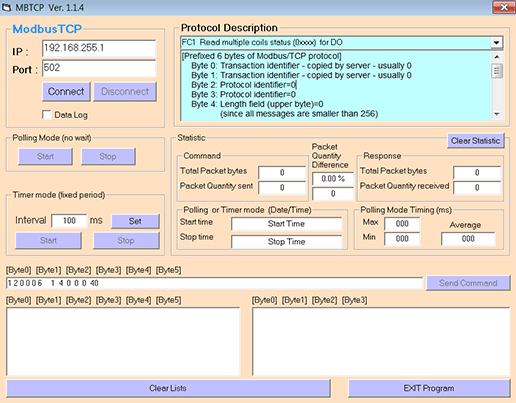
Modbus Master Tool with support for Modbus RTU, ASCII, TCP. Download

Modbus TCP client with support for Modbus TCP. Download
Back to contents
Equipment with Modbus TCP support
Gateway
Industrial protocol gateways provide equipment compatibility of different vendors in one automation solution. Gateways support MODBUS, Tin can, HART and other protocols.
Ethernet Modules ET-7000 /
PET-7000 / tET
Ethernet modules ET-7000, PET-7000, tET of input-output with the Ethernet interface allow to obtain information or to operate devices via the Modbus TCP or Modbus UDP protocols.
Ethernet Expansion Slots ET-87Pn
ET-87Pn-MTCP series is a Modbus TCP I/O expansion unit to expand I-87K series I/O modules over the Ethernet for industrial monitoring and decision-making applications
Ethernet Expansion Slots iDCS-8000
iDCS-8000 series is an Ethernet expansion unit with function of reservation of modules that allows to reserve channels of input-output.
Back to contents
Read Modbus Tcp and Convert to Analog
Source: https://ipc2u.com/articles/knowledge-base/detailed-description-of-the-modbus-tcp-protocol-with-command-examples/
0 Response to "Read Modbus Tcp and Convert to Analog"
Post a Comment