What Do Wild Baby Rabbits Need to Live
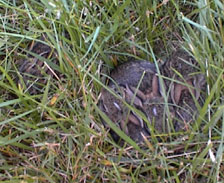
Wild rabbits ofttimes make their nests in areas that boggle our minds... sometimes even right in the MIDDLE of an open 1000. They are "hiding in plain sight" as often the predators that they naturally fear would be also timid to enter those areas. They don't count on the family dog or true cat also beingness a problem!
The way that a mother rabbit cares for the babies limits her time in the nest, which further makes it less likely a predator will find the nest. So if you find a nest of baby rabbits, think twice before doing anything that requires that y'all touch the infant rabbits or disturb the nest.
In Indiana, rehabilitating wildlife requires a license from the DNR. To find a licensed rehabber, delight contact the DNR, a local exotics vet, or the Purdue Academy wild animals data page, which also has more information near cottontail rabbits. Links to national lists of wildlife rehabilitators can too be found in the FAQ below.
- Introduction
- I/My Domestic dog/My True cat Plant a Rabbit Nest! What Do I Do?
- I/My Dog/My True cat Destroyed a Rabbit Nest! What Do I Practice?
- How Do I Know If the Baby Bunnies Need Assist?
- What If the Baby Bunny Is Injured?
- Is there anything I can practice to avoid orphaning baby bunnies?
- The Bunny is Wild and Really Orphaned - How practice I care for it?
- The Bunny is Domestic and Really Orphaned - How do I care for it?
- How much formula should I feed?
Introduction
Many people mean well when they contact House Rabbit Guild after discovering an "abandonded" nest of wild rabbits. Often they wish to "rehabilitate" them with some advice from others. The reality is fewer than ten% of orphaned rabbits survive a calendar week, and the care that people attempt to provide can be illegal, unnecessary, and potentially harmful. The best thing you can practise is to contact a wild fauna rehabilitator in your expanse.
I/My Dog/My Cat Constitute a Rabbit Nest! What Do I Do?
Rabbits "hide their nests in obviously view," often putting them in the open, for case in the middle of the lawn, as well as in brush piles and long grass. If you discover a nest that has been disturbed, do all you lot can to restore and protect it rather than bring the infants within. If a dog has discovered the nest, you tin can put a wheelbarrow over it, so that the mother can go to it but the domestic dog cannot. You tin also protect the nest with a wicker laundry basket with a hole cut in information technology for the mother to enter.
Rabbit mothers nurse their babies for approximately v minutes a day. They will be in the nest or nest box early in the morning and so once again in the evening. The milk is very rich and the babies "make full" to capacity within minutes. Mother rabbits do not "sit down" on the babies to continue them warm as practice some mammals and birds. They build a nest with fur and grasses which helps to keep the babies warm in between feedings. Do not force a mother rabbit to sit in the nest box. You can option up the babies and see if they are feeding by checking the size of their stomachs (should not be sunken in), the pinkness of their skin and activity level (they should not be blue in color or sluggish in move) and the amount of fourth dimension that you hear them crying (infant bunnies should be tranquillity almost of the day....if they are crying constantly then they are non getting fed). If you come beyond a nest of bunnies in the wild and the female parent is no where to be seen, delight DO Non disturb them...this is normal. By removing them from the nest you are greatly reducing their chances of survival.
I/My Canis familiaris/My Cat Destroyed a Rabbit Nest! What Exercise I Do?
Nests can be moved to a safer place up to 10' away from the original site and tin can be reconstructed if necessary. To make a new nest, dig a shallow hole nearly three" deep and put into information technology equally much of the original material equally y'all tin can recover, including the mother'southward fur. Add stale grass as needed, and put the young dorsum. Mother rabbits return to the nest to nurse merely ane or two times a day, staying away as much equally possible so as not to concenter predators. To make up one's mind if the female parent is returning, create a tic-tac-toe pattern over the nest with twigs. Expect 24 hours to meet if the twigs take been removed. If they accept, then the mother is coming back.
How Do I Know If the Infant Bunnies Need Help?
Very young wild baby bunnies with optics airtight and ears back rarely survive in captivity, even given the most expert human care; and so information technology is very important to determine whether they really demand help. Endeavour to assess whether the infants seem warm and healthy or common cold, thin, and dehydrated. Ane examination for aridity is to gently pinch the loose skin at the back of the neck. If it stays in a "tent," the bunny is dehydrated and needs rehabilitation. Another exam is to stroke the genital area to stimulate elimination. If the pee is brown and gritty, the female parent rabbit has non been there to help the bunnies urinate. The brownish, gritty urine is toxic, and the infant bunny must be cared for.
Older babe bunnies who are found outside of the nest may not be orphaned or in need of aid. Baby cottontails are born without fur only develop a full coat in a week. Their eyes open in half-dozen-10 days, and in three weeks they are weaned. At this age, they are about equally round every bit a assistant, and they may explore the globe outside of the nest merely return there to slumber. They are non ignored by the mother but stay with the family unit group until 4 or five weeks of historic period. To determine whether a bunny of this age needs assist, perform the dehydration and urine tests. Likewise expect for haemorrhage, convulsing, fly larvae, broken limbs. (Being moisture does non require hospitalization, I learned!)
What If the Infant Bunny Is Injured?
Either telephone call or take him to your local humane social club or animal shelter/animal control. Call first equally often they will come pick upwards the infant. If they don't accept a wild animals middle, they will refer you. If after hours, contact a local emergency rabbit vet or go to www.rabbit.org and look for a vet in your area. Emergency vet clinics oft are very adept almost helping wildlife until the baby can be transferred to a rehab facility.
The best thing you lot can do for an injured baby bunny is to make it bear on with a skilled rehabilitator.
Smashing info on local rehabilitators tin exist establish at: The Wild animals Rehabilitation Information Directory
Is in that location anything I can do to avert orphaning baby bunnies?
The harsh reality is that many of us who care almost wild baby bunnies may exist contributing to the suffering and decease. Business firm cats who roam exterior will impale about every other time they go out. And dissimilar feral cats who chase considering they are hungry, and kill immediately, business firm cats maul and torment their prey, sometimes skinning infant bunnies alive. Cat owners need to provide managed outdoor habitats for their cats - such as windowboxes or pens.
Lawn chemicals can produce convulsing death in infant rabbits. Co-ordinate to the Animal Poison Control Center, backyard applications that comprise herbicides are not directly toxic to modest animals; but they may make toxic plants more than palatable to them and may make the animals ill for a few days. Products which contain insecticides, such every bit Dursban or Diazinion, which are added to many lawn products to command fleas or grubs in the lawn, are toxic.
The Bunny is Wild and Actually Orphaned - How do I care for it?
The best thing you can exercise for a wild orphaned baby bunny is to make it touch with a skilled rehabilitator. In the meantime, call your local humane society or fauna control and ane of these vets for a wildlife referral: Rabbit Vets United states
A cracking directory of local rehabilitators can be constitute at: The Wild animals Rehabilitation Information Directory
The Bunny is Domestic (NOT WILD) and Really Orphaned - How do I care for information technology?
In the rare situation that you take an orphaned bunny, such as when a domestic rabbit refuses to care for her young, yous will demand to feed the babies. Overfeeding is a leading crusade of death in these youngsters which results in fatal abdominal illness.
Use KMR or Regular Goats milk. Pet nurser nipples on the end of a luer lock syringe, teat cannula on the end of a syringe or Only an eye dropper or 3 cc syringe can exist used to feed. Feed only upright, and point syringe down towards bottom or side of mouth, so if likewise much comes out, the baby does not aspirate. For those who are tedious to learn nursing, SC fluids may be necessary to prevent electrolyte imbalance or aridity (check with a vet on this). Domestic buns with closed eyes should be fed 2-3x/day (but only 2x/mean solar day for wild bunnies), and the number of feedings gradually decreased until they are weaned. If their eyes are still closed, you need to stimulate their bottoms with a warm moist towel after feedings to help them to pee. (Domestics are weaned about 6 weeks; wild bunnies are weaned about three-4 weeks for cottontails and 7-nine weeks for jacks). Bloat is commonly associated with too frequent feedings. KMR is made by Pet-Ag. If y'all have questions, their phone is 800/323-0877. For WILD rabbits, use Regular Goats Milk (found in the carton at your grocery) or KMR, Non Esbilac.
Provide a soft nest surface area in a box with clean towels, and cover the babies so information technology is night. Practice not provide extra oestrus if the room temperature is at least 65 to 70o F because excessive heat can exist fatal. If the room is libation, then you may place a heating pad on a low setting under no more than Half of the nest so the bunny can move to a libation area if it gets also warm. If this is a wild rabbit, handle information technology Only when during feedings as excessive treatment can exist extremely stressful and potentially fatal.
Yous can use KMR (Kitten Milk Replacer) available at most pet stores for the handfeeding formula. You can also use Regular Goats Milk found in the carton at your local grocery store.
How much formula should I feed?
The following is a guideline for the daily corporeality to feed a wild bunny or a domestic bunny. Take the DAILY amount listed and dissever it into proper number of feedings.
Domestic buns with airtight eyes should exist fed 2-3x/twenty-four hours, (2x/solar day for wild bunnies), and the number of feedings gradually decreased until they are weaned. (Domestics are weaned about 6 weeks; wild bunnies are weaned nearly iii-4 weeks for cottontails, and 7-9 weeks for jack rabbits). Bloat is commonly associated with besides frequent feedings.
Wild bunnies should be fed kitten KMR or KMR and regular Goats Milk. Do not employ Esbilac for wild rabbits as we institute they do not do well on that. It is okay for domestics.
- Newborn to One Calendar week: 2 - ii+one/2 cc/ml each feeding (two feedings).
- 1-ii weeks: 5-7 cc/ml each feeding (two feedings). (depending on bunny..may be much LESS if smaller rabbit).
- 2-3 weeks: seven-13 cc/ml each feeding (two feedings). Bunnies whose eyes are still CLOSED need to exist stimulated to urinate and defecate before or after each feeding. Again, seek a professional person on this. Domestic eyes open at almost 10 days of age. Then commencement introducing them to timothy and oat hay, pellets and h2o (ever add fresh greens for wild ones--dandelion greens, parsley, carrot tops, grated carrots, all fresh, watered down). See below for detail.
- three-6 weeks: xiii-15 cc/ml each feeding (two feedings--again, may be LESS depending on size of rabbit! A cottontail will take and then much LESS--about half of this!.)
These small ones (if eyes airtight) all demand to be stimulated to urinate and defecate prior to and following feeding. (Except Jack Rabbits practice non). This can be done by gently running a wet cotton ball (warm water) over the urogenital area. All orphans with open eyes should be offered rolled oats, (whole oats too for wild ones), commercial rabbit pellets, leafy alfalfa, clover, dandelion greens, and some leafy greens. Information technology is IMPORTANT FOR WILD BUNNIES to have mostly OAT HAY, likewise as TIMOTHY HAY AND ALFALFA HAY. The idea is to offer a variety. Some formula may also be placed in a stable dish to encourage self-feeding but discard in a hour or so if not eaten.
If yous have a good for you adult rabbit at home and you can collect cecotropes (the soft green debris that the rabbit normally eats) then these tin can be mixed with the KMR to give the baby bunny normal bacteria for its intestinal tract. Only one cecotrope per twenty-four hour period for 4-v days is needed. This is especially of import for rabbits under one week of age. Also good is to sprinkle acidophilus powder from homo capsules in the milk a little each fourth dimension for healthy flora.
After each feeding it is important to make the bunny defecate and urinate to go on the abdominal tract and urinary system running smoothly (simply until their optics are open). No need to do this for jack rabbits; they get on their ain. Use a cotton ball moistened with warm h2o and gently stroke the anal area until the bunny starts producing stool and urine and keep stroking until the bunny stops. You are reproducing the behavior of the mother rabbit who would lick her immature to stimulate them to get to the bathroom and to go along the nest clean. The stool will be soft and may be varying shades of greenish and yellow.
As soon their optics are open, yous may introduce the bunnies to hay, such equally oat hay, alfalfa and timothy, and dark leafy veggies such every bit carrot tops, parsley, dandelion, romaine, collards, Swiss chard, (apple for wild ones), etc. Dandelion greens are extremely important for jack rabbits. If this is a wild rabbit, you lot practice not need to introduce them to pellets. If this is a domestic rabbit infant, then you may introduce them to pellets at 2 weeks of age (please refer to the handout Care of Rabbits for more information on diet). Wild rabbits should be released equally soon equally they are eating hay and greens and are approximately five inches in body length (cottontails). They will be small-scale, only the longer you continue them, the more agitated and difficult to handle they volition become and the less likely their chances for survival in the wild. Release Only at dusk or dawn. Jack rabbits will be much larger and are released subsequently ix weeks when ready. Brand certain they get exercise daily.
The exception is the length/age rule is the jack rabbit. They are best released around 9 weeks of age, as they mature much slower than the brush/cottontails and need to develop strength. If they are ready, before, they will let you know.
Jack rabbits actually enjoy being raised together, whereas cottontails/castor bunnies may fight and do fine alone. Requite them a carrier equally their place of privacy with plenty of fresh hay, dandelion greens, carrots, carrot tops, whole oats. Brush bunnies/cottontails wean themselves pretty early later on a few weeks. Jack rabbits continue on formula much longer, and most are weaned about 7-9 weeks. Replace the formula with cut-upwards banana or apple.
Sources: Caring for Cricket - What Not To Do When You Find a Wild Baby Bunny past Julie Smith and Handout by Midwest Exotic Animal Hospital, and wild bunny info by M. Wilson (rehabber/HRS).
For more information, delight read Caring for Orphans or email wildbunnyrehab@yahoo.com. This is an e-mail account at the national chapter that specializes in answering questions almost wildlife needs.
What Do Wild Baby Rabbits Need to Live
Source: https://www.indianahrs.org/rabbit-care/wild-rabbits.aspx
0 Response to "What Do Wild Baby Rabbits Need to Live"
Post a Comment